

It is officially the end of an era. Google, the search engine used by billions across the globe to look up virtually anything, recently announced that it is permanently changing its search bar to an AI search bar that will function on its Gemini 3.5 Flash Model. This is the tech giant’s biggest change in the last 25 years, and the ripples of this are already being felt across the industry.
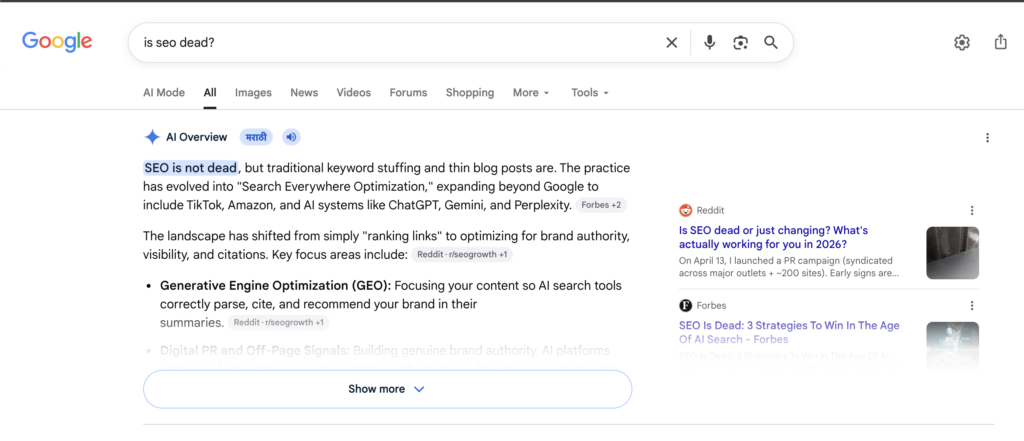
Now, instead of its typical blue link search results, Google will now show a part-page summary of the query, triggering a conversation with AI mode, where users can ask follow-up questions. This basically means that the constant struggle between brands to get their pages, products, blogs etc. on the top of the search results page is virtually over. AI will now decide what comes up first, where the information will be taken from and what to show the user based on its understanding of the query.
This may not feel like a major shift to everyday users, but for SEO managers and businesses that depend on search visibility, which is practically every business on digital, it is nothing short of a generational shift. Naturally, it has brought one larger question back into focus, one that the industry has been debating for some time: is it finally time to start writing the obituary of SEO? Is SEO officially Dead?
The impact of Artificial Intelligence (AI) is palpable across the globe, as it has penetrated every conversation across the globe. This is no small feat considering people who might not even fully understand AI, LLMs, its origins, or even its implications are discussing it. The tech CEOs did tell us that the AI wave was, and is, inevitable and these conversations provide evidence for the same.
However, like we see in most scenarios, for something new to take the spotlight, something old starts fading away. And in the case of AI, the one fading into the horizon is Search Engine Optimization (SEO).
For years, SEO was the name of the game. The one thing that brands spent years optimizing and still so many of them got it wrong. Now, it is being done away with entirely. Mind you this isn’t a slow death either, it is fading fast and there is virtually no stopping it.
So, there we have it: The Death of SEO as we know it. But is it truly the case? One thing we know for certain is that brand objectives will definitely no longer be limited to ranking higher on search. So, what changes? The answer is not really that simple, but it might not mean the complete demise of SEO.
The content will still matter, but the context will be the differentiating factor. That is the part the “SEO is dead” argument often misses. AI can summarise information, but it still needs credible information to summarise. It cannot cite what does not exist, and it cannot build trust for brands that have never invested in useful, clear and authoritative content.
What will die is the older, mechanical version of SEO, where brands chased keywords, backlinks and rankings without really answering the user’s question. What will survive is the larger discipline of discoverability. Only now, it will have to evolve.
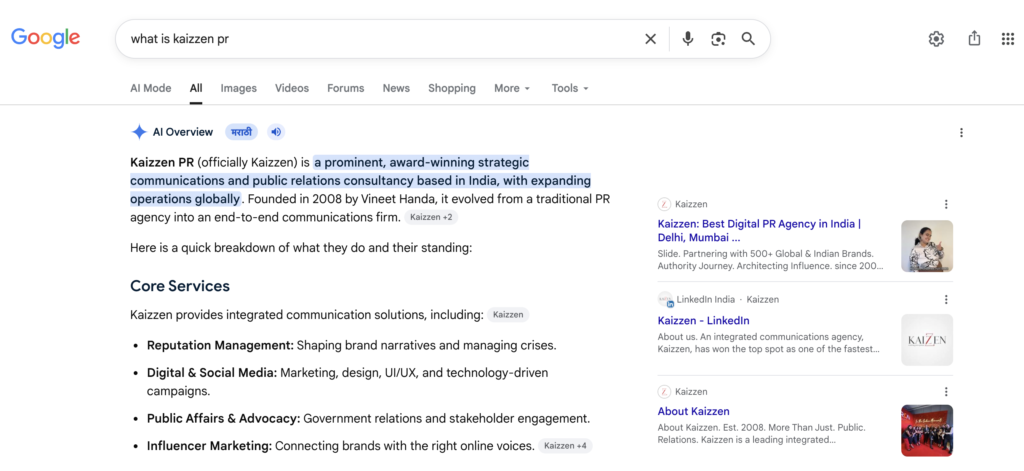
This is where both SEO and GEO, or Generative Engine Optimization, will come into the picture. SEO will continue to matter for the basics: website structure, metadata, page speed, schema, keywords and search visibility. GEO will build on that by helping brands become easier for AI systems to understand, trust and reference in generated answers.
The goal, therefore, will shift from simply ranking first to becoming part of the answer itself. Brands will need sharper content, stronger expertise, original insights, updated information and a clearer point of view. So, SEO is not dead. The shortcuts are. In an AI-first search world, the brands that are genuinely useful, credible and worth finding will still be the ones that win.